What Is an AKSG Model Village?
An AKSG Model Village is a village community working towards family-centred self-governance through value education, responsible participation and practical arrangements for meeting collective needs.
The model proposes that families progressively develop the understanding and capability to participate in education, health, production, exchange and justice. Gram Panchayats, educators, local organisations and participating families contribute according to their respective roles.
Rather than following a fixed set of infrastructure projects, village-level activities are proposed according to local circumstances, available resources and the participation of the community.
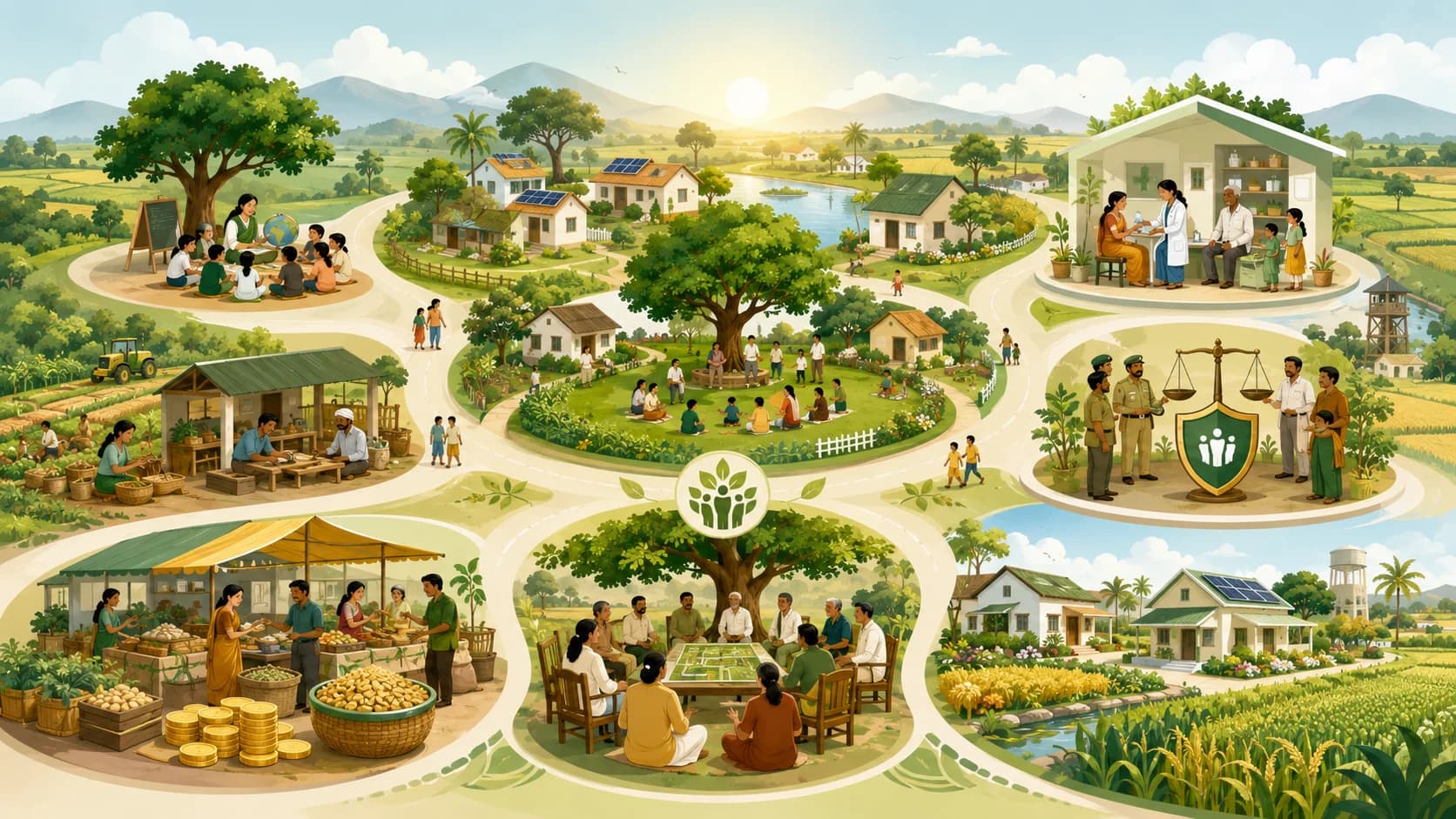
From Participation to Self-Governance
The AKSG framework places responsibility for village development with participating families and the local community.
Education, dialogue and practical work are intended to help families recognise their responsibilities, participate in collective decisions and contribute to arrangements that meet common needs.
This is a working framework rather than a uniform sequence that every village must complete in the same way.
Five Dimensions of Village-Level Organisation
The following dimensions translate the AKSG proposal into areas of work in which families and village communities can participate.
Each dimension includes an educational component and related practical activities. Their development depends on local needs, available capabilities and continued community participation.
Education & Sanskar
PurposeTo introduce Chetana Vikas Mulya Shiksha and develop opportunities for individuals of different ages to understand themselves, human relationships and responsible participation.
Proposed Activities
- Value education for children, youth and adults.
- Introductory Jeevan Vidya workshops and community study discussions.
- Parent–teacher dialogue and greater involvement of parents in education.
- Integration of behavioural education and technical learning.
- Preparing local resource persons who can facilitate continued learning.
- Encouraging self-evaluation, discussion and reflection among learners.
Expected Direction
- Individuals and families develop greater understanding of relationships, responsibility, work and their participation in community life.
Health & Self-Regulation
PurposeTo encourage the understanding and practice of a balanced lifestyle, appropriate nutrition, physical wellbeing, preventive healthcare and responsible care of the body.
Proposed Activities
- Health, hygiene and cleanliness education for children and families.
- Village cleanliness initiatives.
- Awareness of seasonal food, nutrition and balanced daily routines.
- Physical activities, games, exercise and yoga.
- Knowledge of traditional health practices and locally available medicinal plants.
- Health camps and access to relevant healthcare guidance.
- Preparation of local participants for continued health education.
Expected Direction
- Families develop a better understanding of health and establish habits that support hygiene, physical fitness, balanced living and preventive care.
Production & Work
PurposeTo develop productive capabilities that help families meet their physical needs while conserving and enriching natural resources.
Proposed Activities
- Family and school kitchen gardens.
- Participation of children and adults in appropriate productive activities.
- Training in agriculture, related skills and locally relevant production.
- Demonstration activities in farming and agriculture-based enterprises.
- Understanding the relationship between labour, skill, utility and production.
- Conservation of soil, water, biodiversity and other natural resources.
- Encouraging production methods based on natural cycles.
Expected Direction
- Families strengthen their capacity for productive work and develop greater responsibility towards resources used in production.
Exchange & Community Fund
PurposeTo develop an understanding of exchange based on mutual benefit, appropriate evaluation of labour and the responsible use of surplus resources.
Proposed Activities
- Discussions on the distinction between profit-oriented trade and mutually fulfilling exchange.
- Understanding the relationship between family needs, production and prosperity.
- Introducing responsible saving, resource management and appropriate use of money.
- Studying labour-based evaluation and cooperation in exchange.
- Exploring arrangements for a village-level exchange and community fund.
- Developing the understanding needed for transparent and collectively responsible resource management.
Expected Direction
- Families and communities develop a clearer understanding of fair exchange, surplus, savings and shared economic responsibilities.
Justice & Security
PurposeTo develop understanding and practices that support justice in relationships, mutual trust and a sense of security within families and communities.
Proposed Activities
- Discussions on recognising relationships and fulfilling human values.
- Encouraging meaningful participation in family, neighbourhood and Gram Sabha meetings.
- Developing the understanding of responsibility, honesty and mutually fulfilling behaviour.
- Introducing children and youth to collective decision-making through age-appropriate participation.
- Encouraging dialogue and mutual evaluation in relationships.
- Supporting community arrangements based on cooperation and justice.
Expected Direction
- Families and communities develop greater clarity about justice, responsibility and trust in human relationships.
The five dimensions are intended to function together, with value education contributing to the understanding required for responsible participation in each area.
Programme Implementation: Phase I (Five Years)
The first phase of AKSG is proposed as a five-year period for establishing village-level participation, introducing value education and initiating practical arrangements across the five dimensions.
Implementation is intended to be gradual, participatory and responsive to each village's circumstances. The emphasis is on preparing local people and developing the community's capacity to continue the work.
Primary Areas of Work
Village Selection & Baseline Study
Identifying suitable villages, understanding the existing situation across the five dimensions and studying the local community's needs and resources.
Community Dialogue
Organising introductory Jeevan Vidya workshops, discussions and interactions with families, Gram Panchayats and interested participants.
Preparing Local Participants
Identifying Prerak families, interested youth, resource persons and coordinators. Providing appropriate study and training opportunities.
Initiating Village Activities
Beginning value education classes and other locally relevant activities through cooperation among families, educational institutions and supporting organisations.
Review & Improvement
Conducting periodic progress reviews, documenting experiences, evaluating participation and making necessary adjustments.
Working with Local Institutions
Implementation also involves defining responsibilities among different participants.
- Participating familiesStudy, family-level activities and shared responsibilities
- Gram PanchayatsLocal participation, coordination and collective decisions
- EducatorsValue education and learning activities
- Local PreraksCommunity engagement and coordination
- Supporting organisationsRelevant expertise, training and practical support
- Government and service institutionsComplementary services within their respective areas of responsibility
The programme's first phase is intended to establish a foundation for longer-term development, rather than treating five years as the completion of village transformation.
Towards Self-Reliant Families and Villages
The AKSG reference document describes expected developments through five types of participating families. Each corresponds to a particular area of responsibility and contribution within the village.
Long-Term Development
The reference programme describes a development journey extending up to 20 years, with outcomes considered across three periods.
- Years 1–5Establish value education, initiate village activities and develop participating families and local resource persons
- Years 5–10Strengthen family and Gram Sabha participation, community practices and local capabilities
- Years 10–20Develop greater family self-reliance, community coordination and participation in broader humane social arrangements
The programme's longer-term intention is to establish village communities in which families progressively take responsibility for their own needs and participate in mutually fulfilling social arrangements.